

Why Career Mapping Belongs in Your Outplacement Package, Not Just Resume Help
When companies plan a layoff, the outplacement conversation almost always starts and ends in the same place: resume writing and job search support. Those are necessary. They are not sufficient, and for a specific group of affected employees, they can leave a real gap that costs everyone more later.
We’re talking about the employees being let go from a shrinking occupation inside a growing industry.
That distinction matters more than most severance packages account for.
A layoff inside a growing industry is not the same as a layoff in a dying one
The Bureau of Labor Statistics’ 2025–2035 employment projections make this easy to see with real numbers. Computer and mathematical occupations as a group are projected to grow 7.3% over the decade, well ahead of the 3.5% projected for all occupations. That’s the headline most companies and most employees hear.
What doesn’t make the headline: computer programmers are projected to decline 7.3%. Network and computer systems administrators are projected to decline 4.1%. Meanwhile, software developers are projected to grow 10.2%, computer network architects 7.7%, and data scientists 34.6%, all inside the same broad category.
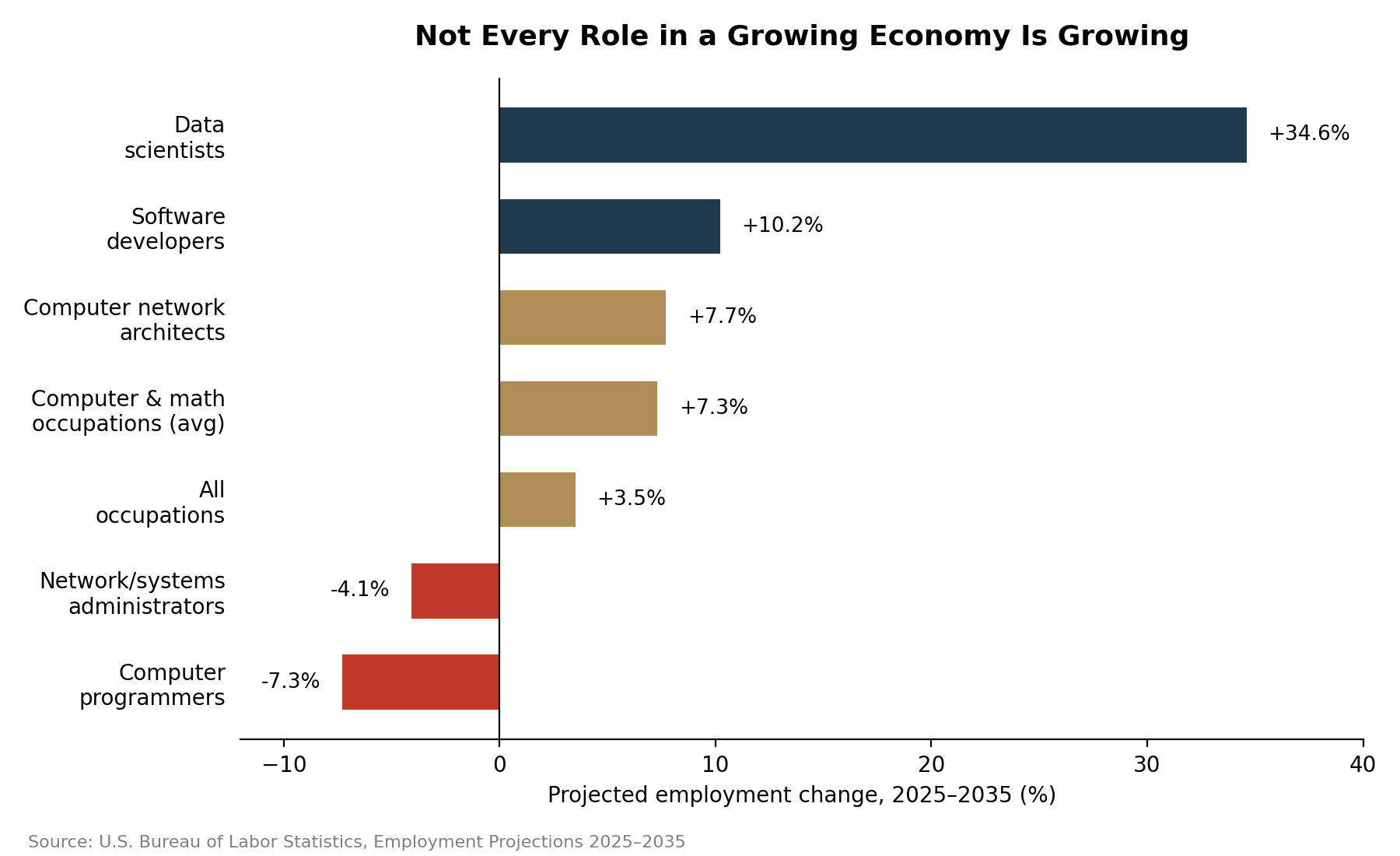
If your company is restructuring, automating, or reorganizing around DevOps, cloud infrastructure, or AI tooling, and the roles you’re eliminating sit in that shrinking slice, your departing employees aren’t leaving a dying field. They’re leaving a specific job title inside a field that’s still hiring, aggressively, for the roles right next to theirs.
That’s a very different situation than a traditional layoff, and it calls for a very different kind of support.
Resume writing answers the wrong question first
A resume answers “how do I present what I’ve already done.” That’s an important question, but it’s the second question, not the first.
The first question is “what should I be presenting myself for?”
An employee who spent 12 years as a systems administrator doesn’t automatically know that their experience overlaps with network architecture, cybersecurity, or cloud infrastructure, three fields with real growth and real openings. Without that context, they default to searching for their old title, in a market where that title is contracting. They apply broadly, hear nothing back, and start to believe the market has no place for them.
It does. They’re just aiming at the wrong target, and no amount of resume polish fixes a targeting problem.
This is where career mapping does the work resume writing can’t. It takes an employee’s actual background, education, transferable skills, interests, compensation needs, and geography, and connects it to where the labor market is actually moving, not where their old title used to sit. For employees exiting a contracting occupation, that mapping step isn’t a nice-to-have. It’s what prevents months of applications into a shrinking pool.
What this costs you if it’s missing
Companies tend to think of outplacement as a goodwill gesture, and it is one. It’s also a business decision with measurable downside when it’s incomplete.
Employees who don’t get real market context tend to job search longer, which extends any outplacement-related costs you’re covering and keeps your name attached to their experience for longer. They’re more likely to end up underemployed or in a role that doesn’t match their compensation history, which affects how they talk about your company to their networks. And in industries with licensing boards, professional associations, or tight-knit communities, that story travels.
There’s also a retention signal here that’s easy to miss. The way a company handles the employees it’s letting go is watched closely by the employees who are staying. A layoff process that visibly helps people land somewhere real, not just somewhere fast, tells your remaining workforce something about how the company operates under pressure.
What career mapping actually includes
For employees exiting a contracting or restructuring occupation, we build this out as a distinct layer of the outplacement engagement, not a bolt-on:
Labor market analysis specific to their occupation. Not “is tech growing,” but where their specific role sits relative to the occupations expanding around it, using current BLS projections and job posting data, not general sector narratives.
Interest and skills assessment. Tools like the Strong Interest Inventory and SkillScan identify what the employee wants to keep doing and which skills travel, so the redirection isn’t just “go where the growth is” without regard for fit.
A realistic path, not just a destination. Whether the next step is an adjacent role, a targeted credential, or a short technical course, we map the actual route from where they are to where the openings exist, including what it will cost in time and money to get there.
Resume and positioning work that follows the map, not the other way around. Once the direction is clear, we know what to emphasize from their existing history. That sequencing matters. Resume work done before the mapping is finished usually has to be redone.
This is especially worth building into layoffs tied to automation or restructuring
If your layoff is being driven by AI adoption, automation, DevOps consolidation, offshoring, or a reorg that’s shifting work across departments rather than eliminating it outright, career mapping isn’t optional context. It’s the most useful thing you can hand a departing employee.
These employees are often losing a job while the underlying skill set they built over years is still valuable, just packaged differently somewhere else in the market. Helping them see that isn’t just compassionate. It’s the difference between an outplacement program that gets people re-employed quickly in roles that make sense, and one that produces a stack of resumes chasing a shrinking title.
We build career mapping into our outplacement engagements for exactly this reason: because the employees who need it most are usually the ones a standard resume-and-job-board package quietly fails.
If your organization has a reduction in force on the horizon, particularly one touching roles affected by automation or restructuring, that’s the conversation worth having before the packages go out, not after the first round of applications comes back empty.
Frequently Asked Questions About Career Mapping and Outplacement
What is career mapping in outplacement?
Career mapping is the process of identifying realistic next-step career options based on an employee’s experience, education, interests, transferable skills, compensation needs, and current labor-market demand.
Within an outplacement program, career mapping helps the employee determine where their background has value next before the resume, LinkedIn profile, or job-search strategy is rebuilt around a new direction.
Why should outplacement include more than resume writing?
A resume is only effective when the employee knows what type of position they are pursuing.
Employees affected by layoffs may need help determining whether to remain in the same occupation, move into an adjacent role, enter another industry, or develop additional skills before beginning a serious job search.
Career mapping gives the rest of the outplacement process a clearer direction.
How is career mapping different from career coaching?
Career coaching can address a broad range of career decisions, job-search challenges, professional development needs, and workplace concerns.
Career mapping is more specific. It focuses on identifying viable career directions and developing a practical path from the employee’s current background to those opportunities.
Career mapping may be one part of a broader career-coaching or outplacement engagement.
Who benefits most from career mapping after a layoff?
Career mapping can be especially helpful for experienced professionals whose occupations are changing, employees who have spent many years with one company or industry, professionals unsure whether their skills will transfer, and individuals who want to change direction but do not want to start their careers over.
It can also help employees determine whether additional training, certification, or education is actually necessary.
Can career mapping help an employee change industries?
Yes. Industry changes often become more realistic when the employee’s experience is examined at the skill and business-outcome level rather than by job title alone.
Project leadership, operations, compliance, analytics, vendor management, customer relationships, process improvement, technology implementation, and people leadership can often transfer into other industries.
Career mapping helps identify where those capabilities are valued and what additional knowledge may be needed.
Does career mapping use labor-market data?
A strong career-mapping process should include labor-market research.
That may include Bureau of Labor Statistics projections, current job postings, compensation information, industry growth, commonly requested credentials, geographic demand, and emerging skill requirements.
The purpose is to avoid recommending career paths based only on personal interest when the market may offer limited opportunity.
Can assessments be used in outplacement career mapping?
Yes. Validated career assessments can add useful information when they are interpreted alongside the employee’s experience and labor-market conditions.
Tools such as the Strong Interest Inventory can help identify patterns in occupational interests, while skills-focused assessments can help clarify transferable strengths and preferred capabilities.
Assessments should inform career decisions rather than make the decision by themselves.
How does career mapping help preserve career equity?
Experienced employees often assume that changing industries or occupations means starting over.
Career mapping looks for ways to preserve the value of their previous experience by identifying adjacent occupations, transferable skills, industry knowledge, leadership experience, and business results that remain relevant.
The goal is usually to build from existing career equity rather than discard it.
Should an employee get a certification after a layoff?
Not automatically.
Before investing in a certification, employees should review job postings for the roles they are considering and determine how often employers actually request that credential.
In some cases, a certification can improve competitiveness. In others, a short course, technical skill, micro-credential, or related experience may provide a better return.
How does career mapping improve resume writing?
Career mapping gives the resume a target.
Once the employee understands which roles they are pursuing, the resume can emphasize the experience, accomplishments, skills, and terminology most relevant to those positions.
Without that direction, a resume may simply summarize the past rather than position the employee for what comes next.
How does career mapping improve LinkedIn positioning?
Career mapping helps determine which expertise, keywords, accomplishments, and professional themes should be emphasized on LinkedIn.
It can also guide the types of content, professional associations, industry conversations, and connections that may help an employee become more visible in the field they are pursuing.
This creates more consistency between the employee’s LinkedIn profile, resume, networking strategy, and interview story.
Can career mapping help with interview preparation?
Yes.
Career changers often need to explain why their previous experience is relevant to a new role or industry. Career mapping helps identify the connections between the employee’s past work and the problems employers need solved.
That gives the employee a clearer story to communicate during interviews.
When should career mapping happen during outplacement?
Career mapping should happen early in the outplacement process, before major decisions are made about resume positioning, LinkedIn branding, certifications, or job-search targets.
The earlier the employee understands the direction of the search, the easier it becomes to align the rest of the outplacement strategy.
Is career mapping only useful for executives?
No.
Career mapping can benefit employees at many levels, particularly when the next move is unclear.
Executives may require more complex positioning because of compensation, leadership scope, and industry specialization, but mid-career professionals and individual contributors can benefit from the same process of evaluating transferable skills, market demand, and realistic next steps.
What should a comprehensive outplacement package include?
A comprehensive outplacement package may include career mapping, resume development, LinkedIn and personal branding, job-search strategy, interview coaching, networking guidance, and labor-market research.
The specific combination should depend on the employee’s needs rather than treating every displaced employee as though they are pursuing the same type of job search.
Why does career mapping matter more during periods of automation and industry change?
Automation can change individual occupations faster than entire industries disappear.
Responsibilities may move into adjacent positions, become more technical, combine with other functions, or require new skills.
Career mapping helps employees identify where the work is moving and how their existing experience may fit into the new structure.

About Bridget Batson & Houston Outplacement
Bridget Batson, CMRW, CERM, CGRA, CPRW, NCOPE, CEIP, CCRS, CCEC, is an 8x TORI Award-winning Certified Master Resume Writer (CMRW), Certified Executive Resume Master (CERM), Certified Career Resilience Strategist (CCRS), and the Owner of Houston Outplacement LLC. A former Fortune 500 Recruiter and contributor to the 9th edition of Resumes for Dummies, Bridget bridges the gap between high-level talent and the modern hiring landscape. She also runs the career blog, Bridget Batson.
Through her firm, Houston Outplacement LLC, a WBE and WOSB-certified business, she provides end-to-end career solutions for both individuals and organizations:
-
For Individuals: Bridget Batson, through her firm, Houston Outplacement, offers private consultations and high-authority resume development, interview coaching, career mapping, career coaching, ghostwriting, personal branding, and Myers-Briggs STRONG Interest Inventory assessments, leveraging her status as a Certified Graphic Resume Architect (CGRA) and Nationally Certified Online Profile Expert (NCOPE) to help executives stand out in a “copy-paste” digital world.
-
For Corporations: Houston Outplacement serves as a strategic partner during organizational shifts, providing compassionate, human-centric outplacement services, intern transition programs, and layoff assistance that protect employer branding and support departing talent.
-
Public Speaking & Training: Bridget is a sought-after speaker on the topics of Career Resilience, Personal Branding, Corporate Etiquette, and Modern Hiring Strategy, helping teams navigate the intersection of human talent and AI-driven recruitment.
Credentials & Certifications: Certified Master Resume Writer (CMRW) • Certified Executive Resume Master (CERM) • Certified Graphic Resume Architect (CGRA) • Certified Professional Resume Writer (CPRW) • Nationally Certified Online Profile Expert (NCOPE) • Certified Employment Interview Professional (CEIP) • Certified Career Resilience Strategist (CCRS) • Certified Corporate Etiquette Consultant (CCEC) • Myers–Briggs STRONG® Administrator.
Ready to move beyond the generic? Schedule an Individual Consultation or inquire about Corporate Outplacement services at Houston Outplacement.